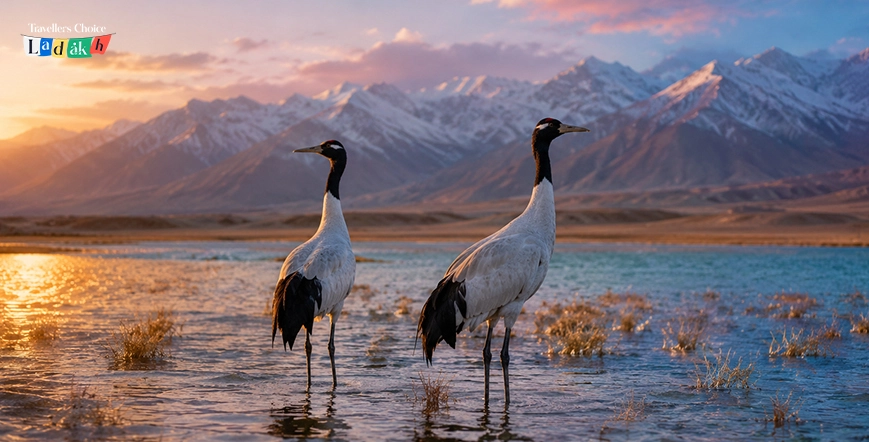
Sacred Wings & High-Desert Myths: The Black-Necked Crane Festival 2026
Imagine driving across a barren high-altitude desert at 14,000 feet, only to find an endangered bird that local nomads treat like royalty.
Welcome to the Changthang plateau.
In this rugged realm, the black-necked crane (Cha Thung-Thung) isn’t just wildlife. It’s a sacred protector, a harbinger of good luck, and the undisputed star of local mountain culture.
With UT Ladakh launching its inaugural celebration across Leh, Tso Kar, and Hanle, the Black-necked Crane Festival 2026 is about to change how travelers experience the high desert. Here is a look at the local folklore and legends about the festival, and why this high-altitude gathering belongs on your bucket list.
1. Sacred Messengers and Flying Saints
To understand why locals care so deeply about this bird, you have to look beyond standard birdwatching. The connection is rooted deep in ancient Ladakh folklore.
For centuries, Changpa nomads living near Tso Kar and Hanle have believed that cranes bring rain, fertile pastures, and good fortune to their herds.
Understanding black-necked crane folklore starts with their spiritual standing in Tibetan Buddhism. Monks believe that when a pair of cranes circles high above a monastery before landing in the marshlands, they are performing Kora, the sacred Buddhist ritual of circumambulation. Ancient black-necked crane legends even claim that high lamas and saints were carried across dangerous Himalayan passes on the backs of these birds.
Harm one? According to local belief, that’s a quick way to invite bad karma onto your entire village.
2. The Dance That Inspired Mountain Culture
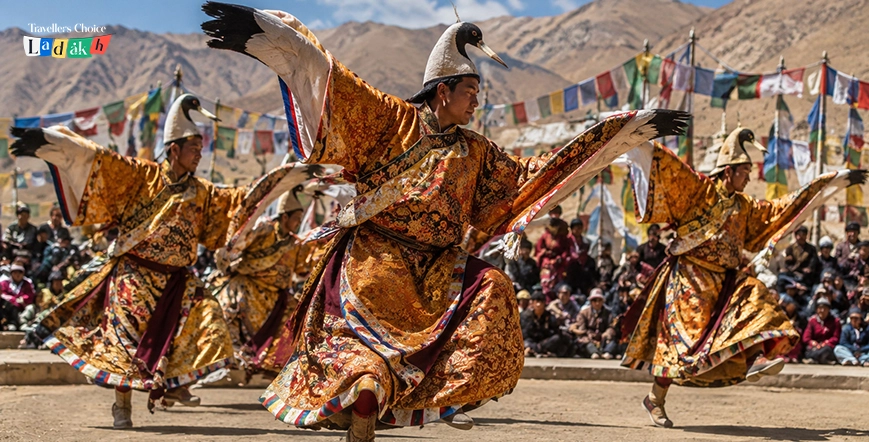
If you’ve ever seen crane courtship rituals, you know they don’t just walk around-they put on a show. They bow, flap their wings in sync, and leap high into the thin mountain air.
Locals loved this dance so much they turned it into art.
Unlike standard Ladakh festivals that focus strictly on monastic rituals, local dances like Chartses mimic the bird’s exact movements. Performers in silk robes hop and flutter their sleeves to celebrate love, spring, and the thawing of frozen rivers. Spotting a black-necked crane in Ladakh pairing up in early spring signals to pastoralists that the brutal winter is finally over.
That’s why the Black-necked Crane Festival 2026 isn’t just another tourist event. It’s a genuine celebration of survival and co-existence.
3. What to Expect at the Festival
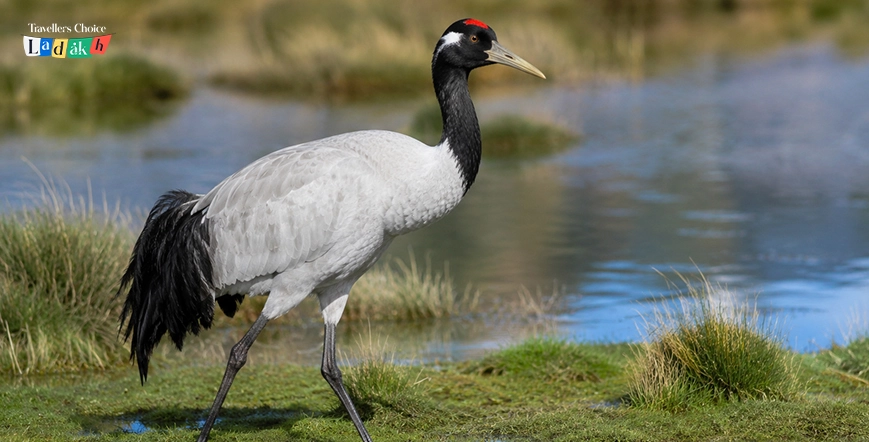
This landmark bird festival in Ladakh bridges high-altitude wildlife conservation with cultural storytelling. Instead of staying in one spot, the event spreads across the Changthang region.
- Scientific Conferences in Leh: Global birding experts and researchers gather to discuss wetland protection.
- Changpa Cultural Shows in Tso Kar: Authentic Changpa dance performances, folk music, and local nomadic food.
- Guided Wetland Birdwatching: Expert-led walks around Tso Kar to spot breeding crane pairs and wild asses (Kiang).
- Dark Sky Stargazing in Hanle: Cosmic viewing sessions under some of the clearest, least polluted skies on the planet.
If you love wildlife, this high-altitude bird festival offers a rare mix of science, culture, and extreme scenery.
4. Practical Crane Festival Guide: How to Get There
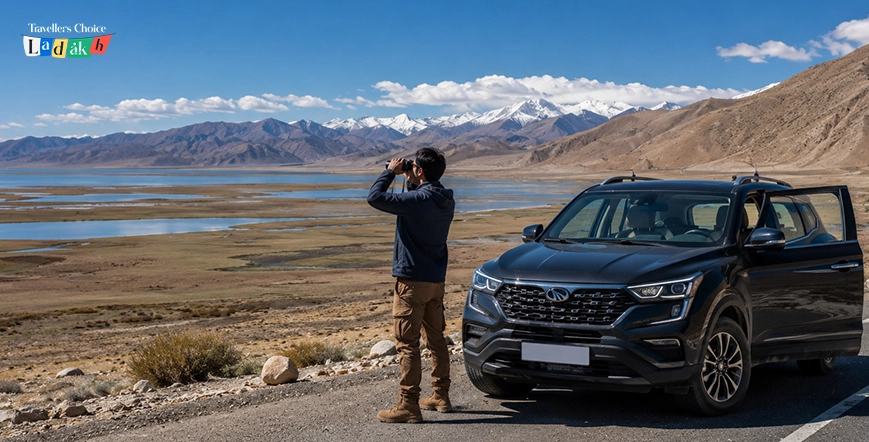
Planning your trip around the black-necked crane festival 2026 requires a bit of prep. Tso Kar and Hanle sit well above 14,000 feet, where the air is thin, and facilities are basic.
First, take at least 48 hours to get used to the altitude in Leh before heading up to the wetlands. Secondly, Inner Line Permits (ILP) will be required in places such as Hanle, which are readily available in the town itself.
Because roads across the Changthang plateau get rough, having a reliable 4×4 is non-negotiable. You can easily rent a sturdy vehicle from our private cab rental fleet to handle high passes comfortably.
Want to explore more avian hotspots while you’re out in the wetlands? Check out our complete bird watching guide for Ladakh to track migratory species across alpine lakes.
The Verdict
It’s not just a festival of the Himalayan region; it’s a festival you can enjoy from the sofa. Do not trample over fragile marshlands, avoid nesting pairs, and enjoy the show.
Pack your thermal layers; the high desert is waiting.
Frequently Asked Questions
A festival to celebrate the conservation and culture of the sacred black-necked crane by the Ladakh community of UT. The festival consists of bird observation, Changpa folk activities, and sessions of scientific talks and stargazing in three locations, namely, Leh, Tso Kar, and Hanle.
The best spotting locations are the high-altitude wetlands of Changthang, specifically Tso Kar, Hanle, and the marshy shores around Tso Moriri.
Yes. No special permits are required in central Leh, but special permits called Inner Line Permit (ILP) are needed in festival places such as Hanle and protected areas in Changthang for citizens and foreigners.
Please keep 100m away from the shores of wetlands, avoid low-flying drones, keep to marked paths, and avoid making loud noises that may disturb breeding pairs.